Last week, I had again one of those conversations that a few years ago completely shifted how I think about business processes. You know the kind - where someone drops a casual observation that suddenly makes everything click into place.
I was talking about Event Modeling workshops, and how we use red sticky notes to mark knowledge gaps on our process maps. Simple concept, right? When we don’t know something, we slap a red note on the board and keep moving.
Those red sticky notes aren’t marking failures - they’re marking discoveries.
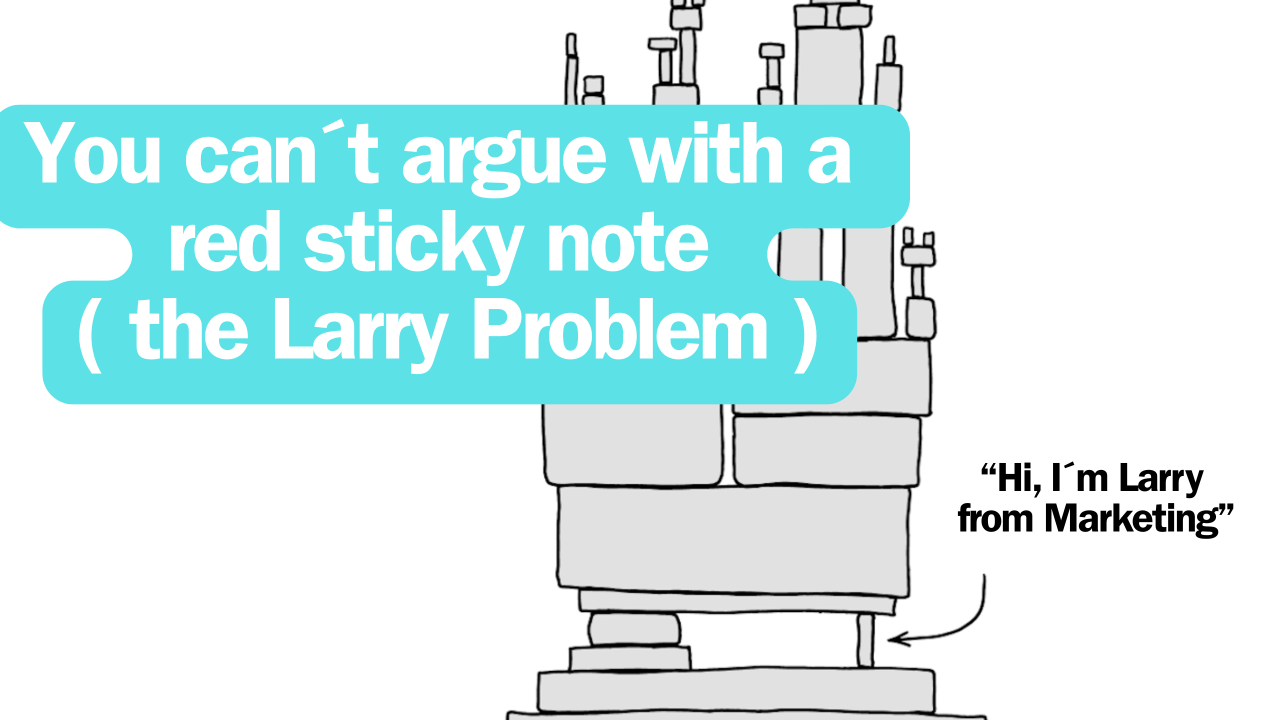
The Larry Problem
Every company has a Larry. You know Larry - he’s the guy from Marketing who manually updates “that spreadsheet” every morning at 7 AM. The one where if Larry gets sick, half your customer onboarding process grinds to a halt. Larry doesn’t think he’s critical - he’s just being helpful. Meanwhile, he’s a single point of failure holding million-dollar processes together.
The thing is, Larry’s invisible in your org chart. He’s not documented in your SOPs. But he’s absolutely critical to your Event Model.
When we map out what actually happens (not what the process documentation says happens), Larry emerges from the shadows. Along with his spreadsheet. And his tribal knowledge. And his 7 AM alarm clock that your entire business depends on.
The Polite Conspiracy of Silence
Here’s what I’ve learned after all those modeling sessions: most business process failures aren’t technical problems - they’re truth-telling problems.
There is someone who knows the process is broken. They’ve known for months, maybe years. But in most corporate environments, you are either not head or even worse, rewarded for not speaking up. Stay quiet, don’t rock the boat, let someone else take the risk of being wrong.
Politics.
So teams build software for processes that don’t actually exist. They automate workflows that are held together with digital duct tape and good intentions. They spend months building “exactly what was requested” - which turns out to be completely wrong.
Event Modeling changes this because you can’t lie to a visual model. When you have to literally draw out what happens next, the gaps become visible to everyone in the room. The polite conspiracy of silence crumbles when faced with a board full of red sticky notes.
Visual Evidence
those red sticky notes give you permission to deliver bad news without being the bad guy.
You can’t walk into a C-level meeting and say “Your processes suck.” But you can show them an Event Model blinking in blood red and say “Every red sticky note represents a potential problem.”
It’s not YOU saying their system is broken - it’s the MODEL saying it. The problems were always there, hiding in plain sight. You just made them visible.
And suddenly, what was once threatening becomes tactical. Instead of defending broken processes, teams start counting red sticky notes. “We started with 47 unknowns - let’s see if we can get down to 30 by Friday.”
You’ve turned organizational dysfunction into a measurable, solvable game.
The Questions That Matter
Next time you’re in a requirements meeting, ask yourself:
- How many “Larrys” are holding this process together?
- What are we pretending to understand that we actually don’t?
- If we had to draw this process step-by-step, where would the red sticky notes go?
Because here’s the truth: what is made visible can be tackled.
Your biggest business problems aren’t hiding in complex technical architectures. They’re hiding in the gaps between what people say happens and what actually happens. They’re in the knowledge that lives in Larry’s head but nowhere in your documentation.
The red sticky notes just help you find them.
Ready to uncover what’s really happening in your business processes? The next Event Modeling Mastery Workshop will happen in October 2025 - only 12 spots available. 2 days, 2x 4h - teaching you the foundatios of Event Modeling. Because sometimes the most valuable discovery is admitting what you don’t know.
Martin Dilger Founder, Nebulit Making the invisible visible, one red sticky note at a time
Ready to Learn More?
My book “Understanding Eventsourcing” gives you the blueprint. But reading alone will take your team too long.
I can teach your team how to build these blueprints faster and skip the whole trial-and-error phase. Let’s have a chat about how this applies to your project.
Want to learn how to apply Event Modeling and Event Sourcing in practice?
Follow the Online Course “Implementing Eventsourcing” - comes with a Lifetime Event Modeling Toolkit License.